Update July 21st, 2026: Arthur Perret has responded to this article. He makes some incredibly good points, and has a few additional ideas that I didn’t think of. I highly recommend reading his response after this article. In addition, based on his response, I have added a few updates throughout this article at places where I felt I could emphasize or clarify a few things.
For years now, as the maintainer of one of the leading writing apps in the academic space, I have had to answer this one question hundreds of times: “How do we organize our knowledge appropriately? How do we manage our notes so that we never forget something, always find notes again, and get productive in writing anything from blog posts to entire books?” And it’s a valid question. We live in an age of “publish or perish,” where even academics are required to show more and more productivity every single day. If we don’t publish we don’t get the grant money nor the jobs required to do the research we want to do.
This has led to a fear of being inefficient. When we write something down, we want to use it. If we have an idea but don’t write it down, we are wasting our brain power. Because that idea could be part of one of those many papers we are expected to write. If we see something online, we want to persist it somewhere inside a space where it will resurface at the right moment, to be used in one of those outputs. Nothing should go to waste.
But what do we do once we have all of this data, all of this information in our knowledge databases? Our elaborate workflows with two or more apps that all are supposed to synergetically work together in presenting us our casual thoughts when we most need them?
This is where innovations in the writing space from the past decade come into play. There is the ominous graph view, the apex of productive writing; a visualization of notes together with their links, spatially sorted so that we can identify productive clusters of knowledge that is just waiting to be molded into a paper. Then there are the whiteboards, the outlines; those blank canvasses where we can arrange our thoughts and notes to produce clusters where they do not yet exist; turn our ideas into a structure that resembles a paper. And so on.
The siren calls of “productivity” are plentiful. From every corner some Instagram or YouTube influencer tells us how we can juice a few more inches of productivity out of our own workflows. Our writer’s block is not caused by us just having a dearth of ideas at the moment; no it’s because we aren’t holding our tools right.
“Ten essential plugins to supercharge your Obsidian workflow!”
“How to actually take smart notes!”
“Harnessing the insane productivity of one German academic!” (of course it’s Niklas Luhmann)
All of these could be clickbaity titles to some twenty-minute YouTube tutorial that promises to turn your brain into a sponge that you can squeeze on command and which will then just randomly pop out a submission-ready paper.
But here’s the thing: All of this is snake oil. All of this is going to waste your time and prevent you from actually being productive. Because none of this is how paper writing and having ideas works.
This whole productivity discourse is a distraction. None of those YouTubers who promise you to improve your workflow are per se wrong. None of the books on how to “take smart notes” are lying to you. But they aren’t going to help you actually get more productive, either.
If you have spent any amount of time in the online note-taking discourse, you may have recognized the title. It’s a play on Sönke Ahrens’ book “How to Take Smart Notes.” That book counts as the “bible” among the note-taking community. If you haven’t read the book, “you are doing it wrong.”
A few days ago, I met with my friend Sam. Over a beer we chatted about various things. One of these things was the note-taking and productivity discourse. And he said a few things that brought a lot of my thoughts on note-taking together and gave me a very important insight:
We ought to take notes in order to write papers. The note-taking discourse treats those notes as the final end product, not what you will need to do with them: writing papers.
This insight perfectly encapsulates the issues I have had with this discourse over the years, and gave me a few ideas on how to think about this for myself. And just like we should take the phrase “How to Take Smart Notes,” and turn it into “How to Smartly Take Notes,” this is exactly how this discourse works, and the secret to actually being productive.
The Purpose of Note-Taking
To get started, let us first revisit the purpose of note-taking. Why do we even take notes? Why do we jot down random thoughts? We do that because we have another goal: writing a paper.
Note-taking is never a goal in itself, it is just one of the means to get there. When we take notes, those are not supposed to be the final “product.” This also means: Notes shouldn’t be well-formatted, they do not need to be free from grammatical or typographical errors. They should be rough, maybe even a bit odd, and most importantly only useful for yourself.
A note quite literally should be a throw-away-thing that serves its purpose through the act of writing itself, and not through re-surfacing it again. Notes are supposed to be single-use, or maybe even zero-use. A note is always a good note once you have it. You don’t have to reuse it at some point for it to actually matter.
Sam mentioned that he writes a lot of notes down on paper. On a paper that he then promptly throws away. Why? Because it suffices to having written it. Once a note has been put into writing, that typically suffices to reinforce the neural pathways in your brain enough for it to “stick.”
I personally often don’t even take notes anymore. When I sit in a lecture or a seminar, I typically keep my laptop closed and listen. Sometimes I do take notes whenever the speaker says something crucially important to me. But that’s a rare occurrence.
I see many people in those seminars and lectures frantically writing everything down. All the time. At conferences, I see the same people sitting in front of me writing, and writing, and writing. In the first session, the second session, the keynote. Every syllable spoken in the front lands in their note apps.1 At the end of the day, they will have about ten pages worth of notes from all the things that happened on that day. And they will do the same tomorrow. I always wonder: what use will those notes have? Do you actually look back at them at some point, and realize some great ideas hidden in there? And, more importantly: is every speaker that you see equally relevant to your work?
Again, I do take notes during lectures, but I have learned to be very selective in when I do that. I feel that whenever I write down something the speaker says, I don’t listen to what they are saying. In those situations, my brain is busy formulating the idea in my own words, and I will miss any sentence the speaker says while I am typing. That’s why I typically don’t write during lectures.
This is all the more true when I listen to a speaker who works on questions unrelated to my own research. I don’t need to take any notes because the specifics of what they say probably won’t ever be relevant to my own research. But if I listen carefully, I may recognize how they approached their research on a meta level.
The whole purpose of note-taking is to reinforce the neural pathways that encode the idea. But this reinforcing also takes away your attention. As long as you write, you can’t listen to the speaker.
More importantly, however, we actually should not reinforce those pathways too early. Think of it like this: whenever you write something down, you signal to your own brain that it’s important. And in formulating your ideas and spending the mental energy to form the letters on your paper, your brain realizes: “I should probably keep this somewhere easily accessible.” And this can be a danger.
Taking Notes Can Cause “Lock In” Effects
There is this effect in psychology called “priming.” If we have no idea about some fact, then our brain will instantly store the first explainer for this thing we hear as fact. Take as an example the concept of Aokigahara. This is the Japanese art of reinforcing ideas and concepts you learned over the day via quiet reflection.
Except it isn’t. It’s just some forest at the base of Mount Fuji. But if you never heard the term Aokigahara before, the first statement I mentioned sounded probably very true. At least it made sense from what you probably knew about Japanese culture (which, if you’re a Westerner like me, is probably full of stereotypes, let’s be real). And if I hadn’t immediately clarified it, your brain would have stored it as fact. And then, when another person, maybe with less authority than me, would’ve corrected this misinformation, it would be much more difficult to rewire your brain again.
Why am I saying this? Because I realized over the years that, if I write down ideas too quickly, I can sometimes “lock myself in” to a very specific reading of some fact. For example, imagine you sit in a conference session and the presenter talks about how what they are doing is called “political sociology,” and what they are doing is outline the influence of the welfare policies on care-work in precarious families. Then you write down “Political sociology does research on care-work.” Would this be wrong? No, absolutely not. But it’s also just one particular reading of the entire discipline, which has much more to offer than just this one strand of research. And then when someone else also does the influence of welfare-policies on care-work in precarious families, but does this from a segregation perspective, they would probably not think of themselves as a political sociologist.
If you hadn’t written this fact down previously, the connection between “care-work” and “political sociology” would not have been reinforced all that much. And then it would be easier for your brain to connect the research more broadly with social science, and left open the possibility of political sociology describing a specific type of social scientific research.
Now, this doesn’t mean you should never write anything down. That would also be wrong. But there is a sweet spot between writing everything down as soon as you hear it, and never writing anything down. Instead, it’s a good idea to write things down only after some period, once you’ve been exposed to an idea multiple times from multiple angles.
The Fallacy of Never Throwing Away Ideas
This leads to another point we discussed: the fear of missing out (FOMO). We often take notes because we are afraid that we might never have this idea again. Here’s another uncomfortable truth: if you have an idea, then you lose it, and you never have it again, was it really a useful idea? Was the idea really worth writing down?
Think about it: We all have hundreds of silly ideas every day. And most of them are rubbish on second thought. If you were to write all of them down, you’d have a huge pile of unnecessary ideas burying some good ideas. But how are you supposed to figure out which ideas in your notes are great and which are not?
When YouTube influencers discuss “the perfect workflow,” they will oftentimes make a call to authority to argue why it is of utmost importance to “take smart notes” instead of boring simple notes. They will typically talk about Niklas Luhmann (of course), but I have also seen them argue that smart people like Albert Einstein have probably also taken very smart notes, because how else would they become so relevant?
Well, there’s another concept, called survivorship bias. Let’s start with a picture (from Wikipedia):
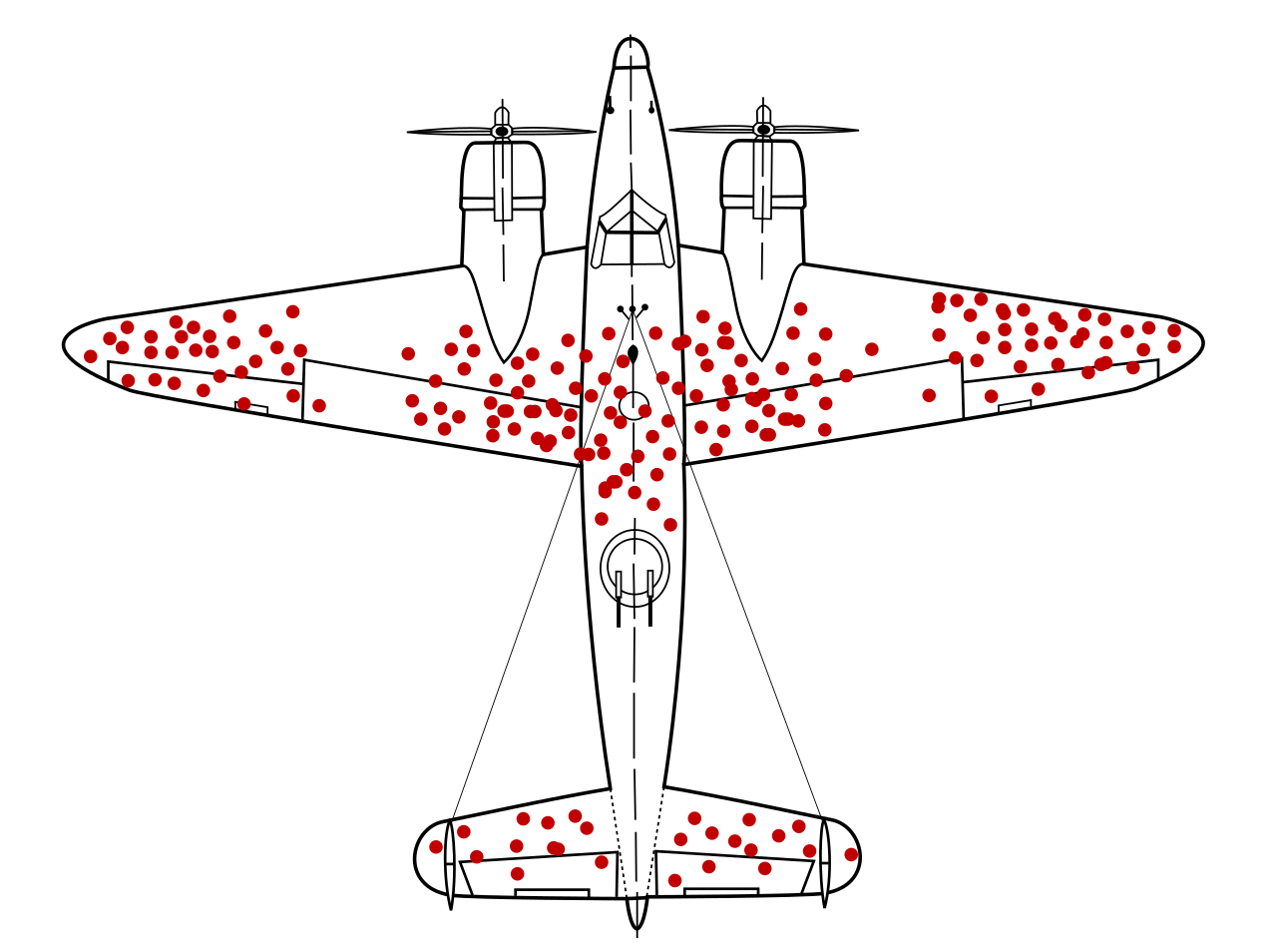
This is a famous diagram in statistics. It’s a top-down view of a World War II airplane. When the allies wanted to improve the durability of their bombers they sent to occupied Europe, they started to take notes. Basically, you cannot make a plane perfectly armored against enemy flak, because airplanes need to maintain a balance between weight and durability. So they wanted to figure out where exactly to place additional armor to be as efficient as possible. Each plane was inspected, and wherever the statisticians found a bullet hole, they would mark it on this diagram. As you can see, most planes had damages concentrated in the wings and directly behind the cockpit.
Where do you think, based on this image, the mechanics should place additional armor plates? That’s survivorship bias: they should probably place more armor plates in areas where there are zero markings, because the planes that were hit in those places did not make it home and thus could not be inspected.
The same holds true when someone invokes a famous academic to argue why taking “smart” notes is important. We have no idea how many thousands upon thousands of silly ideas Albert Einstein had during his morning coffee that he never wrote down because he knew they weren’t great.
Whenever I have a new idea, I never write it down. Instead, I apply a form of filter to ensure anything I do write down at least has the merit to be remembered. Since most ideas are silly, I never write down any brand-new idea. Instead, I ponder it and move it around in my head for a day. I think about it from multiple angles, maybe do some googling on the side. Then, when I wake up the next morning, and that idea is still in my head, then I do write it down. This is the first step of filtering possibly good from silly ideas. And I have a bunch of other workflows that ensure that, as ideas progress from being a possibly silly idea to a solid research project, I weed out more and more of those until only a few but very solid ideas remain, like a sieve.
In essence: be bold, and dare to throw away your ideas. If an idea reoccurs on its own in your head, that’s always a good sign. If it doesn’t then you won’t even remember that you ever had that idea. This way, you also save your brain power to actually take in good ideas.
Influencers Are Not Your Friends
At some point, Sam made a very relevant statement. I feel a bit embarrassed that I didn’t think of it, but it makes perfect sense: Influencers make money with taking “smart” notes, because for them the notes are the end-goal. Notes and a nice-looking graph are the product. Influencers don’t perform your job of having to write actual papers. They make YouTube videos reviewing a bunch of writing tools and giving you “Ten tips to improve your writing.”
Now, don’t get me wrong: Most YouTubers are decent people. They spend weeks researching their videos and present you accurate information about the workflows. However, they also make money with their videos. For them, a nice-looking graph is a selling point. For them, having a lot of data in the apps to show you a big list of “relevant concepts” is a selling point.
Update July 21st, 2026: Arthur writes “[…] I remain attached to graph views for some use cases. The first time you visualize your notes as a network is important: it triggers a realization that what you are creating is denser than a list of files in a folder.“ When I emphatically position myself against a graph view, it is not because I want no one to use it. Rather, it comes from the realization that graph views tend to be flashy marketing tools. They are impressive visualizations that are great content for YouTube videos or Instagram Reels, and as such they are omnipresent in the online note-taking discourse. If a good graph view makes your brain go faster, then please use it. My critique merely is that tools should not matter, unless they help you, and I fear that the graph view is being pushed a little too hard because it is such great content.
This does not mean that you should stop watching those videos, because there is always something new and genuinely helpful in them. What I am saying is just that you shouldn’t take these videos at face value. Always reflect: “Is this feature they’re reviewing something that serves my goal of writing a paper, or does it only look good?”
To hammer home the point: Whenever I watch Technology Connections I have this strong urge to buy an Air Conditioning system and a solar array. But then I remember that I only rent. Whenever I watch Hardware Haven, I feel an urge to go shopping for a new server. But then I remember that I already have a bunch of servers that all perform perfectly well. Whenever I watch Jeff Geerling, I have this urge to buy a Raspberry Pi, and when I watch LTT, I have an urge to upgrade my GPU, etc. You get the point.
I never followed through on these urges. But with software reviews, this is more difficult, because it’s not like you would have to spend $2,000 to follow through. You simply download software, and you just try out the workflows. There is typically no monetary value attached to it, so the threshold of “just giving it a shot” is very low. But every single recommendation from one of these YouTube videos is an entire rabbit hole, and if you “just try it out” it can lead to having spent five weeks picking your “perfect” workflow without ever having written a single useful word. (Believe me, I’ve been there. More than once.)
The Purpose of Productivity Tools and Writing Workflows
Finally, let’s reflect a bit on the actual purpose of all those productivity tools and writing workflows out there. They all serve one goal: writing papers. (Or whatever form of text or research you actually need to perform; I’m just referring to papers since that’s my end-goal, but this article applies to anything where you’d need a writing tool.)
The purpose is never to take “smart” notes. The purpose is to just “have” a good workflow. None of this matters if you can’t perform your actual work. Every app, every workflow, and even every type of note you have in your system must only be measured by its ability to aid you in your work.
For example, I don’t take “fleeting notes,” anymore. I don’t follow a workflow where I jot down a thought and iterate over a bunch of different stages until I end up with a “permanent note.” Because none of that actually helps me in writing papers. I still have a folder called “Zettelkasten,” but the last time I checked it was maybe four years ago. And I’m still fine. I’m still writing a lot (evidence: this research blog), and I don’t feel like my ideas are running out.
Do you want to know what actually helps me? Having a good full-text search. Having ideas and notes clearly connected to the papers they come from. And having those separate from my own ideas, and research. Having a central location for all my papers at various stages.
A graph view is complete nonsense for me, because if a good full text search doesn’t surface some thought, it’s simply not relevant for my work. Sure, I might overlook interesting thoughts, but then again, they are probably not necessary for the purpose of writing the paper. If they were, I would do multiple searches until I found the note. Because the reason I do multiple searches is that I need to double-check something I faintly remember having somewhere, and that’s typically a sign that whatever I’m looking for is important. And it’s not unheard of that I would take notes I accidentally found at some point, and move them to a more prominent place because I recognize that they are much more central than I thought at first.
What I want to say is the following: None of your apps actually matter. What matters is if you can achieve your goal of writing a paper. If you can do it, then your apps are probably sufficient. If you can’t, then the first step is not to look for another app that promises to solve this issue, but instead to reflect on your workflow. What is necessary to get a paper written? And where do you face difficulties?
I know plenty of colleagues who still only use Word. Some even write LaTeX in a plain text editor without syntax highlighting. And they’re doing fine. Because the apps they use just work for them. Again: the apps aren’t important. Whether you make it to a final paper matters.
Update July 21st, 2026: Reading this section now, a few weeks after having written it, I can see how one might get the impression that I am leaning hard towards a “return to monke” stance, as the memes would have it. “Throw away all your tools and go back to Notepad.” But that’s not what I want to say. This article is primarily a critique of the tendency to value tools over workflow, and thus I did not spend too much time outlining good tools. But of course, good tools exist. I make one myself! We all have reference managers and various small tools that make our work easier. There are a lot of good tools, and even more ideas for potentially good tools that don’t yet exist. So please keep in mind that I don’t want to insinuate that workflow is everything, and tools are crutches. I will come back to this more in a follow-up.
Research is a Trade
This leads me to a last, overarching point: research is a trade. It’s not some wizardry where a cabal of elites would congregate to cast spells to make knowledge appear ex nihilo. Research is hard work. And it is iterative work. It is comparable to the work of a carpenter.
Carpentry starts from a living tree, and ends with a finished chair. You first need to fell the tree, cut it into logs, and then transform the logs until you can screw them together to have a chair. Doing research is barely different. The main difference to carpentry is that research only happens in your head. Yes, we have data, and we can run analyses — but these analyses are never the core of the research. They are actually just serving a purpose to test some hypotheses that we have. And where do these hypotheses come from? Well, those are the few good ideas among the haystack of silly ones. Also, we never know if what comes out of our work is a chair or a cupboard. But the steps to get from a coarse idea to a finished paper are always the same.
And for that reason, neither your tools nor the way you take notes are at the center of what you do. It’s that anything you do eventually ends up in a well-written, well-researched paper. And since we do this all in our head, it is not obvious which tools will work for every individual researcher.
My PhD supervisor, for example, has one big, large, Word document for each semester in which he takes notes sequentially. When the semester ends, he summarizes them, puts the document away, and opens a blank new one. To me and my brain, this approach seems unhinged. I could never work like this. But he is a highly productive researcher, and he publishes a decent amount of work every year. Because for him, these are the tools and workflows that work.
This is also why I am always hesitant in explaining how I work. I always have this nudging doubt that when I explain how I work, that a bunch of people may take this at face value and grow frustrated because what works for me might be just as unhinged for them as other workflows seem to me.
To conclude, I only want to reinforce one argument I made: Stop thinking about the tools you use. Stop thinking about the workflows.
If Word works for you, then please, use it. If Zettlr works, then please, use it. Or Obsidian. Or Telegram. (Yes, I have friends who take notes in Telegram. Don’t ask me how, I wouldn’t know.)
The only metric that should count when you evaluate whether your existing workflow works for you is: Are you happy with the amount of papers you are writing? Do you feel like some step in your process always slows you down? Which one is it? Start from there. Not from tools, graph views, outlines, or other fancy features.
Stop trying to take “smart” notes. Start taking notes “smartly,” that is: in whichever way works for you.
There was a guy doing exactly that at the last conference I visited, and it made me think: “Does he really believe he’s going to use all of that in six months from now?” ↩